
- Feb 26
- 5 min read
Updated: Mar 11
Watch the full webinar on our Youtube HERE or at the video below!
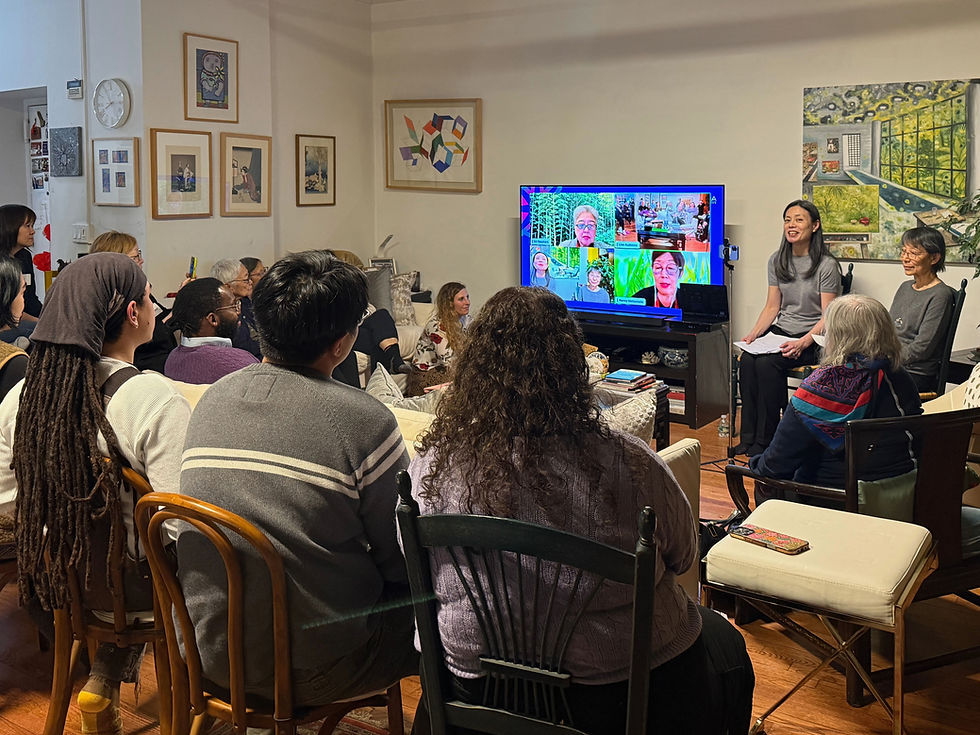
After a weekend of historic snow in NYC, we were delighted to enjoy the warm of a community gathering on February 24 for Serica Storytellers: Poetry, Memory, and Remembrance!

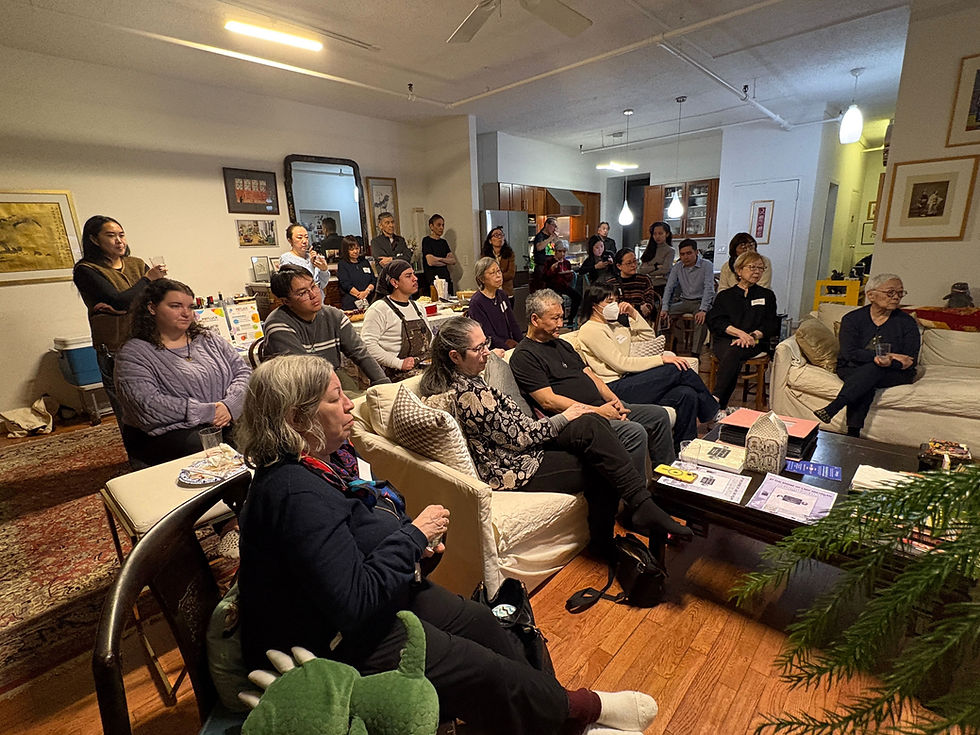
In partnership with our friends at Potluck Asian America, AAPI community leader Julie Azuma welcomed us into her home to commemorate the Japanese American Day of Remembrance for a special evening of joyful community sharing, overflowing with food, poems, histories, memories, and more!
Stepping into Julie's loft space was a treat for the senses. The smell of homecooked food at the front door betrayed the potluck feast awaiting attendees, with favorite Japanese dishes like yakitori, sushi, and ebi fry — complemented with additional homemade contributions from the community. As attendees filled their plates and connected with old friends and new, the sound of chatter rose in the air, wrapped around sunny yellow walls and endearing Gozilla-themed decor.

Japanese American History, Literature, and Identity in By the Shore of Lake Michigan
The program began with opening remarks from Andrea Louie, Executive Director of the Serica Initiative and Sue Lee of Potluck Asian America.
Next, writer and editor Nancy Matsumoto introduced By the Shore of Lake Michigan, the award-winning English translation of a 1960 tanka poetry collection written by Tomiko and Ryokuyō Matsumoto — an Issei couple forcibly incarcerated at Heart Mountain during World War II and later resettled in Chicago. For Nancy, this was a deeply personal project, as Tomiko and Ryokuyō Matsumoto are also her maternal grandparents.
The Matsumotos, originally from Chiba Prefecture in Japan, had settled in Seattle in the 1920s, before later moving to Los Angeles. During World War II, they were incarcerated at Heart Mountain, Wyoming and were later resettled in Chicago after the war's end. Throughout these tumultuous times, the Matsumotos chronicled their emotions and experiences with tanka poetry.
Nancy shared how her relationship with her grandmother and their shared appreciation of writing led to her 15 year journey of translating their tanka poetry collection. In 2010, she began exploring their poetry, originally as a personal family project. At this time, Kyoko Miyabe, moderator for the event, joined Nancy in digitally archiving the collection and translating the poems.
Five years later, they presented a completed version at the annual meeting of the Tanka Society of America. Based on the feedback they received there, they decided to recruit a professional tanka translator: Mariko Aratani, who coincidentally lived only 10 minutes away from Nancy! Three years later, they connected with UCLA's Asian American Studies Center Press, where the editor suggested finding someone who could write an introductory essay that could bridge both academic and popular audiences. This is where Eri F. Yasuhara joined the team of incredible storytellers. From there, it took another six years to get the translation to publication in 2024.
Next, Mariko Aratani spoke about the long, significant, and storied 1300-year history of tanka poetry in Japan. Consisting of 31 syllables structured in 5 lines of 5-7-5-7-7 syllable pattern, the tanka poetic form has communicated an extensive range of diverse, deeply emotional, and profoundly personal expressions throughout its history. Thus, Mariko noted how the Matsumotos were well-suited to express their emotions and experiences of incarceration through tanka.
"For some reason, the rhythm of the five and seven syllables sounds so pleasant, natural, and expressive to japanese people's ears."
— Mariko Aratani
Mariko shared how tanka's significance in Japanese culture is owed to its rhythm and brevity. The short form lends itself to easy engagement and a natural sound and timing, and its form is embedded in everyday life in Japan: posters, advertisements, slogans, song lyrics, and more. But it is deceptively simple, Mariko noted. Though anyone can write tanka, it requires a lifetime to truly master it.

"While being incarcerated in the camp, stripped of their freedom and facing uncertainty, they turned to tanka to express their emotions and preserve their cultural identity. in the barren environment with little connection to the changing seasons or natural beauty, they found solace in the 31 syllables that had shaped their lives."
— Mariko Aratani
Next, each speaker shared 2 poems from By the Shore of Lake Michigan they found especially meaningful. Eri F. Yasuhara shared two poems from Tomiko Matsumoto: the first from her time of internment, and the second marking the day of the McCarran-Walter Act of 1952, which allowed Japanese immigrants to become naturalized US citizens. Eri spoke to how By the Shore of Lake Michigan, which spanned a 17-year period of the Matsumotos' lives, reflected an evolution in their identity from Japanese immigrants, to an imposed label of "enemy aliens," to proud Japanese American citizens.
In the spirit of a community gathering, Kyoko Miyabe shared two poems from Tomiko that captured a motif of hope and growing their lives in the United States, even amidst their gruesome conditions of internment.
To enjoy
cultivating
a patch of land
in this big city of Chicago--
also a harbinger of spring
hitotsubo hodo no / tsuchi o tanoshimi
tagayasu mo / daito shikago no
haru no saikgake
— Tomiko Matsumoto
As the book talk drew to a close, we moved forward into a time of community sharing, where attendees shared about their history, experiences, and emotions around the Day of Remembrance.

Riki Eijima from Day of Remembrance NYC spoke about her background as a fourth-generation Japanese American (Yonsei) and how commorating historical struggles, like those of the Matsumotos, is important for us to recognize and provide aid for the ongoing struggles of marginalized peoples and communities today.
Host Julie Azuma also shared her experience growing up Japanese American in NYC, and how oftentimes third-generation Japanese Americans (Sansei) would need to force the second-generation Japanese American (Nisei) to talk about their incarceration experiences. Through community organization (practicing mock testimonies and submitting their stories), they were eventually able to receive some reparations from the US government. Julie also generously shared photo albums and documents showcasing her family's history.
Other community members also shared meaningful stories of their families' experiences, including cross cultural mutual aid, where Black American communities in San Francisco offered resources and aid to Japanese Americans who moved in after resettlement.
We are so grateful to everyone who helped create such a meaningful evening honoring community, memory, and culture! ❤️ A special thanks to our host Julie Azuma; our partner Potluck Asian America; our Serica Storytellers: Nancy Matsumoto, Kyoko Miyabe, Eri F. Yasuhara, and Mariko Aratani; and Tomiko and Ryokuyō Matsumoto, whose poetry, memory, and strength continue to live on.
Where to Buy By the Shore of Lake Michigan

By the Shore of Lake Michigan is currently in its third-edition printing at the UCLA AASC Press, and is anticipated to be completed in early March. If you are interested in purchasing a copy of By the Shore of Lake Michigan, you may fill out the interest form HERE to be notified when the book becomes available (or scan the QR code on the flyer)!


This program is supported, in part, by public funds from the New York City Department of Cultural Affairs in partnership with the City Council.
The Serica Initiative thanks the New York State Council on the Arts for the generous grant support. The opinions, results, findings and/or interpretation of data contained therein are the responsibility of the Serica Initiative and do not necessarily represent the opinions, interpretations or policy of the State.


