
.png)
Updated: Jul 13
Companies just have a more complicated global, geopolitical, and regulatory environment to deal with then ever before [with supply chains].
Serica News: Navigating AI, Supply Chains, and Strategic Risk with Paul Triolo
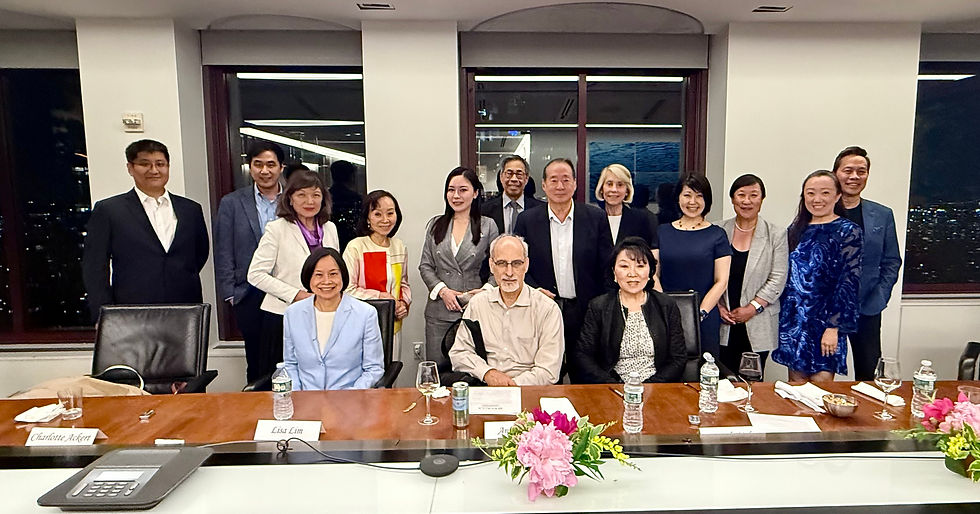
On May 26, members of The Serica Initiative community joined an intimate CEO Dinner conversation featuring technology policy expert Paul Triolo,
Partner, China Technology and Global Technology Policy Lead at the DGA Group, Asia Society Senior fellow, and more. He is one of the world's leading analysts of artificial intelligence, global technology competition, and U.S.-China relations.
Before the dinner, CINGS member Santini Wei had the opportunity to sit down with Triolo for a deeper discussion on some of the most pressing challenges facing businesses today: AI governance, supply chain resilience, and the growing intersection of technology and geopolitical risk. You can watch their interview at the bottom of the page and read more about his insights below.

As governments, corporations, and institutions race to adapt to rapid technological change, Triolo emphasized that many of the defining questions of the next decade are no longer purely technical. Instead, they center on governance, trust, and the ability of organizations to navigate increasingly complex global environments.
AI's Biggest Challenge May Not Be Technology
When asked whether artificial intelligence adoption is becoming more of a governance challenge than a technological one, Triolo noted that competitive advantage may increasingly depend on how organizations manage risk, privacy, security, and user trust rather than simply gaining access to the latest models.
"Governance matters," Triolo explained, particularly for multinational companies operating across multiple jurisdictions. While AI capabilities continue to improve at an extraordinary pace, organizations must develop safeguards that protect data, ensure privacy, and maintain user confidence.
Many companies, he noted, are already implementing internal best practices designed to prevent models from exposing sensitive information or personal data. Their motivations are practical: corporate reputation and customer trust are valuable assets that can be quickly damaged by misuse of AI systems.

At the same time, governments around the world are struggling to keep pace with technological advancement. While the European Union and China have already implemented comprehensive AI regulations, the United States has moved more slowly toward a unified federal framework.
Triolo suggested that the coming months could bring increased pressure for stronger oversight of advanced AI models, particularly as policymakers seek to better understand their capabilities and potential risks. In the absence of clear federal standards, some companies are already evaluating compliance with emerging state-level regulations as a pathway toward responsible deployment.
He also highlighted the growing importance of international dialogue. As AI systems become more powerful and globally deployed, conversations between major powers—including the United States and China—may become increasingly necessary to establish guardrails and shared approaches to managing risk.

The New Era of Supply Chain Strategy
The conversation also explored how multinational companies are rethinking global supply chains in the aftermath of COVID-19 and amid escalating geopolitical tensions.
For decades, global supply chains were largely optimized around a single principle: efficiency. Companies focused on minimizing costs, maximizing speed, and concentrating production where it made the most economic sense.
That assumption no longer holds.
Today, Triolo explained, businesses must evaluate a much broader range of risks, including geopolitical conflict, cyberattacks, climate-related disruptions, regulatory changes, and resource scarcity.
"You can't structure supply chains today without taking geopolitical risk into account," he noted.
As a result, many companies are investing heavily in crisis management and scenario planning, stress-testing operations against potential disruptions that would have received far less attention before the pandemic.
The challenge is particularly acute in sectors that rely on highly specialized components, rare earth minerals, and sophisticated manufacturing ecosystems concentrated in specific regions of the world. While many firms have pursued "China+1" diversification strategies by expanding production into countries such as Vietnam or Thailand, Triolo cautioned that these transitions are rarely simple.
Building new supply chains requires infrastructure, workforce training, supplier development, and significant time investments. In many industries, alternative sourcing options remain limited.
The broader lesson, according to Triolo, is that businesses are operating in a fundamentally different environment than they were just a few years ago.
"Companies just have a more complicated global, geopolitical, and regulatory environment to deal with than ever before."
Looking Ahead
Throughout the discussion, a common theme emerged: resilience is becoming as important as efficiency.
Whether deploying AI systems or managing global supply chains, organizations are increasingly being judged not only on their ability to innovate, but also on their ability to anticipate risk, adapt to uncertainty, and build trust across stakeholders.
For leaders operating in today's interconnected world, the challenge is no longer simply keeping up with technological change. It is understanding how technology, governance, and geopolitics are becoming inseparable—and positioning their organizations to succeed at the intersection of all three.
We are grateful to Paul Triolo for sharing his insights with the Serica community and to CINGS member Santini Wei for helping facilitate this thoughtful conversation. Enjoy the video interview below and comment your thoughts!


