

From a Columbia computer science pioneer to an AI poet exhibited at MoMA, meet the extraordinary voices gathering in New York City on November 4 for The Serica Initiative's 2026 AAPI Trailblazers Conference.
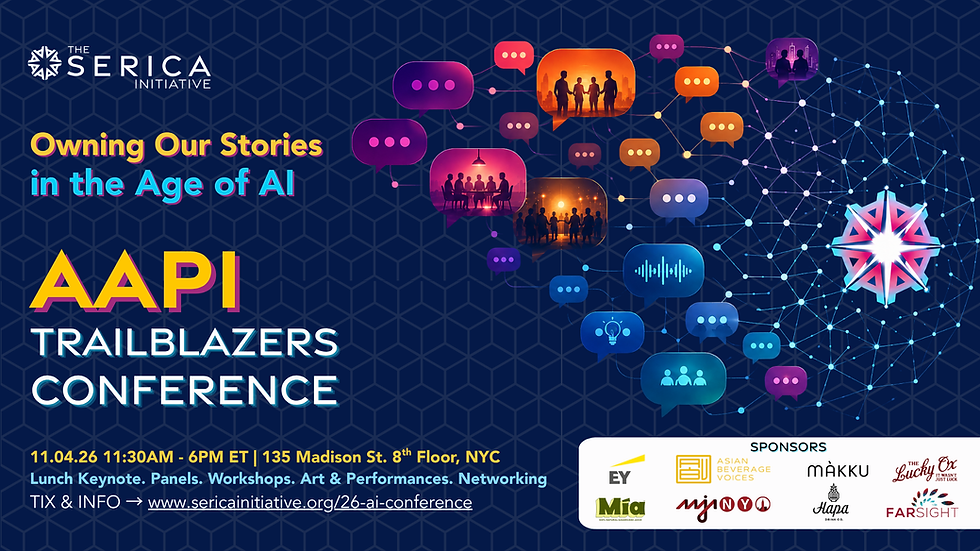
Artificial intelligence is learning from us. But whose stories will it tell?
Imagine a future where a machine can write a poem in your voice, reconstruct a dance from decades past, recommend your next career move, or explain the history of your community to someone who has never encountered it before.
That future is no longer entirely hypothetical.
Artificial intelligence is already changing how we work, create, communicate, and understand the world. Yet as we race to develop increasingly powerful technologies, an equally important question deserves our attention: Who gets to shape them—and whose experiences will they carry forward?

For Asian American and Pacific Islander communities, these questions are particularly consequential. Our communities have contributed enormously to American innovation, culture, and society, yet our stories have not always been fully represented in the histories and narratives that shape public understanding.
Now, as AI systems learn from existing information and cultural records, we face both a risk and an opportunity: Will these technologies reproduce the omissions of the past, or can we help build a future in which more of our stories are heard?
On Wednesday, November 4, 2026, The Serica Initiative invites you to explore these questions at our 2026 AAPI Trailblazers Conference: Owning Our Stories in the Age of AI, held at Blender Workspace in Midtown Manhattan.
With an extraordinary lineup spanning technology, business, journalism, academia, and the arts, the conference will explore three interconnected questions:
Who shapes the future? How do we navigate it? And who tells our stories?
Here are the trailblazers helping us find answers:

Jeannette M. Wing: What Will It Take to Build AI We Can Trust?
Long before AI became a daily conversation, Jeannette M. Wing was helping change how the world understands computing.
Her seminal paper, Computational Thinking, helped establish the idea that the principles of computer science could transform problem-solving across disciplines.
Today, as Executive Vice President for Research and Professor of Computer Science at Columbia University, her work focuses on one of the defining challenges of our era: trustworthy AI.
A former Corporate Vice President of Microsoft Research, Wing is an elected member of the National Academy of Engineering and a Fellow of ACM, IEEE, AAAS, the National Academy of Inventors, and the American Academy of Arts and Sciences.

On November 4th, Wing will deliver our headlining keynote, asking what it means to build powerful technologies that society can responsibly trust.
From Entrepreneurship to Community Leadership: Building What Comes Next
Lily Xu: Opening Doors for the Next Generation of Founders
For Lily Xu, innovation is about more than developing the next breakthrough product. It's also about who gets the opportunity to build one.
A former startup founder who successfully exited her company, Xu now leads global startup and AI ecosystem initiatives at Amazon Web Services.

Her accelerator programs have supported more than 2,000 startups worldwide, connecting entrepreneurs with the resources, expertise, and networks needed to grow.
Her work has particularly emphasized opportunities for underrepresented founders.
Xu will headline our Trailblazers Lunch, sharing perspectives on entrepreneurship, opportunity, and leadership in a rapidly evolving innovation economy.
Paul Cheung: Why Our Communities Must Help Shape the Future
For more than 25 years, Paul Cheung has worked to expand opportunity, representation, and innovation in media and public life.
Now President of Committee of 100, Cheung previously held leadership positions at NBC News, The Associated Press, and The Wall Street Journal, among other organizations.
Through his involvement with Hacks/Hackers, he also champions conversations about how emerging technologies, including AI, can strengthen journalism and the broader information ecosystem.

Cheung will deliver our closing keynote, bringing the day's discussions back to a central challenge: how can AAPI communities move beyond adapting to technological change and become active participants in shaping it?

Shelly Xu: Can AI Help Eliminate Waste from Fashion?
For Shelly Xu, the future of AI is not just digital. It's material.
As Founder and CEO of SXD, Xu is using patented AI-powered design technology to rethink how products are created, challenging the assumption that waste is an unavoidable cost of manufacturing.

With three utility patents, recognition for Top Innovative World Technology at SXSW, and the Global Change Award—often described as the “Nobel Prize of Fashion”—Xu is turning an ambitious sustainability vision into practical innovation.
Her company works with more than 20 brands across fashion, automotive, and homegoods, demonstrating how AI can create possibilities that conventional design processes struggle to achieve.
Xu joins our discussion, Who Shapes the Future? AAPI Leadership in the AI Era, exploring what it means to lead, innovate, and build more responsible businesses.
Brian Pang: Who Gets a Seat at the Table?
Technology doesn't transform society on its own. The people leading organizations, building products, and making decisions matter just as much.
Brian Pang, Founder and Principal of SKYROCKET Management Consulting, brings experience spanning product development, business strategy, technology, and community empowerment.

A former Product Development Director at Electronic Arts, Pang has worked at the intersection of digital innovation and consumer experience. Beyond his professional career, he is Co-Executive Director of the Asian Leaders Alliance and Founder of Asians in Gaming, championing greater opportunity and visibility for Asian professionals.
At Trailblazers, Pang joins the conversation about what meaningful AAPI leadership can look like as AI reshapes industries and the workforce.
Moderated by Di Cai, Serica Board Member and Partner at Sander's Capital, Di brings a unique perspective understanding how impactful storytelling can be from her experience bridging the perception gap between the US and China through stories and laughter. As a stand-up comedian, she has toured North America and Asia, with performances at Kenan Presents, the Apollo Theater, Tokyo Comedy Bar, and the Seattle International Comedy Competition. As a storyteller, she has toured nationwide with The Moth Mainstage and is a four-time Moth StorySlam champion.

Your Career in the Age of AI: Beyond the Hype
Dr. Ngoc Cindy Pham: How Do We Stay Valuable in an AI Economy?
For many professionals, the most immediate question about artificial intelligence isn't philosophical.
It's personal.
Will AI change my job? Which skills should I develop? How can I use these tools without losing the judgment, creativity, and perspective that make my work valuable?

Dr. Ngoc Cindy Pham is helping people answer those questions.
An Associate Professor at Brooklyn College, CUNY, Pham founded the BRIDGE AI Lab, developed the BRIDGE Framework for Equitable AI Literacy, and created the CUNY AI Literacy & Professional Readiness Series.
Her work focuses on translating technological possibility into meaningful economic opportunity, particularly through practical, ethical, career-ready AI education.
At the conference, Pham will lead Owning Your Career in the Age of AI: A BRIDGE Workshop, an interactive session designed to help attendees think critically about their own professional futures and identify concrete ways to navigate the changing workplace. It's a place for you to contemplate what you do next with this valuable tool.
Sasha Stiles: Can a Poem Be Alive?

What happens when a poet collaborates with a machine that never stops writing?
For Sasha Stiles, this is more than a thought experiment.
A poet and language artist, Stiles is the creator of A LIVING POEM, an infinitely regenerating poetic work created in collaboration with her AI alter ego, Technelegy.
The work challenges familiar ideas of authorship, language, and creativity. If a poem is continually evolving, where does the artist's work end and the machine's begin?
Stiles' work has been recognized with the Prix Ars Electronica and Lumen Prize, exhibited internationally at institutions and events including MoMA and Art Basel, and supported through her appointment as a Google Arts & Culture Artist-in-Residence.

A LIVING POEM was exhibited at MoMA across 2025–2026.
At Trailblazers, Stiles will bring these questions to life through a special hybrid poetry and audiovisual performance, inviting attendees to experience AI not merely as a technological tool, but as a creative collaborator.
Xin Ying: Can Technology Preserve a Dance?
A dance exists in the moment it is performed. A gesture, a movement, a breath—and then it disappears.
But what if technology could help preserve and reinterpret that movement for future generations?

Xin Ying, a Principal Dancer with the Martha Graham Dance Company since 2011, has spent her career exploring what movement can communicate beyond words.
Praised by The New York Times for a performance described as “transcendent and heroic,” Xin Ying is also an interdisciplinary artist investigating the relationship between dance, technology, memory, and digital archives.
Her project Lamentation: Dancing the Archive received the 2024 Google Artist + Machine Intelligence Faculty Research Award, supporting an exploration of how interactive technologies can transform the ways audiences encounter historic dance.
At Trailblazers, Xin Ying joins a discussion on the future of AAPI narratives, asking how emerging technologies might help preserve cultural expression while opening entirely new possibilities for creativity.

Rubina Fillion: Reinventing Journalism from Inside The New York Times
Rubina Fillion, Deputy Editorial Director of AI Initiatives at The New York Times, is working at the intersection of journalism and emerging technology.
Her work explores how AI and machine learning can support journalists and create new experiences for audiences, while navigating the responsibilities that come with introducing these technologies into the news ecosystem.
Previously Director of Strategy for New York Times Opinion, Fillion has also held roles at The Wall Street Journal and taught journalism at Columbia University and NYU.
Bourree Lam: The Future of News—and Whose Voices Get Heard
Bourree Lam has spent her career thinking about how journalism reaches people, evolves, and remains relevant.

An experienced editorial leader whose career includes The Wall Street Journal, The Atlantic, Refinery29, and the Mozilla Foundation, Lam was among the early members of the Wall Street Journal's AI task force.
At Refinery29, she helped create #NotYourTokenAsian, an initiative aimed at increasing the visibility of Asian American writers and creators.
Her perspective brings together two challenges facing media today: adapting to technological disruption while ensuring that a changing information landscape doesn't leave important voices behind.
Qin Gao, Ph.D.: Making Asian American Communities Visible Through Data
What happens when a community's experiences are missing from the data used to shape public understanding and policy?
Qin Gao, Ph.D., Director of the Asian American Initiative at Columbia University, has dedicated her research to understanding inequality, social policy, and the lived experiences of Chinese and Asian American communities.
A professor at Columbia's School of Social Work, Founding Director of its China Center for Social Policy, and author of Welfare, Work, and Poverty: Social Assistance in China, Gao brings a research-driven perspective to the relationship between representation, data, and social change.

Her work reminds us that visibility is not merely symbolic. It can influence the decisions institutions make and the futures communities are able to build.
Tina Wang: Connecting Journalism, Culture, and the AAPI Community
Moderating this conversation is Tina Wang, President of the Asian American Journalists Association's New York Chapter.

An award-winning journalist and cultural critic whose work has appeared in TIME, NBC News, and other publications, Wang examines the intersections of innovation, art, identity, and social justice.
Her work has earned recognition including a Gracie Award, and her leadership in AAJA reflects a commitment to strengthening journalism and amplifying voices too often overlooked.
Together, these five perspectives will anchor Who Tells Our Stories? AI and the Future of AAPI Narratives, one of the conference's defining conversations.
Why This Conversation Matters Now
There is no shortage of conferences about artificial intelligence.
But AI is not simply a technology story.
It's a story about who gets opportunities, how careers evolve, which voices are heard, what cultures remember, and what it means to be human in an increasingly automated world.
We believe the future of AI shouldn't be shaped by technologists alone.
And Asian American communities shouldn't simply be represented in that future.
We must help build it.
Join Us November 4 in New York City

Whether you're a technology professional, entrepreneur, artist, educator, student, community leader, or simply someone curious about how AI is changing our world, we invite you to join this conversation.
Expect thought-provoking keynotes, candid cross-sector discussions, an interactive AI career workshop, a special artistic performance, and opportunities to connect with people whose perspectives may challenge and inspire your own.
And because the best conversations often continue after the program ends, we'll close with Conversations, Culture & Cocktails—an opportunity to meet fellow attendees, speakers, and community leaders over drinks and light bites.


