

"we need spaces where you can eat your sandwich and sit in the sun" - Billie Tsien
Contributed by Michelle Maiuri, Events Director
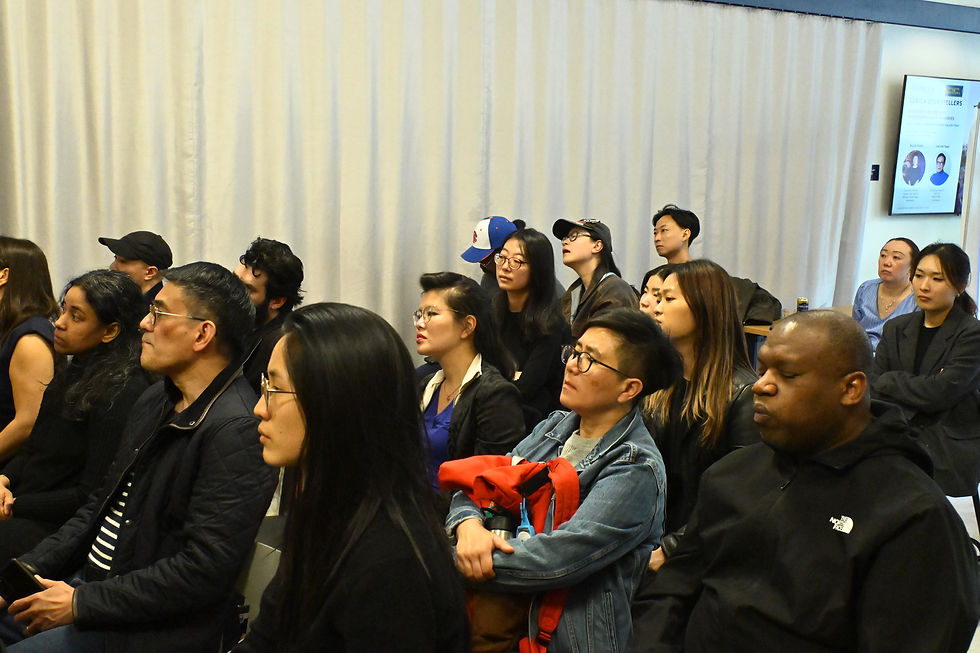
Last week, The Serica Initiative welcomed a full and deeply engaged audience to Welcome to Chinatown for Serica Storytellers: Billie Tsien in Conversation with Calvin Tsao — Architecture Serving Neighborhoods & Memories, an intimate evening exploring architecture as service, memory, and cultural belonging.

Set in the heart of Manhattan’s Chinatown, the salon-style gathering brought together architects, students, artists, entrepreneurs, and local residents for a rare public conversation between Billie Tsien and Calvin Tsao—two of the most influential voices in contemporary architecture today.

Billie Tsien has a large illie Tsien—co-founder of Tod Williams Billie Tsien Architects and Studio Tsien—has helped shape some of the country’s most celebrated civic and cultural spaces, including the Obama Presidential Center, the Barnes Foundation, and Asia Society Hong Kong. Calvin Tsao, a leading voice in architecture and design culture, is known internationally for his multidisciplinary practice and his influential leadership roles across institutions including The Architectural League of New York and The American Academy in Rome.

Rather than beginning with buildings, the evening opened through stories of family, immigration, and identity. Tsien reflected on her mother, a Chinese immigrant and biochemist whose courage and independence shaped her worldview as a first-generation Chinese American growing up in a predominantly white suburb.
“What I realize more and more,” Tsien shared, “is the courage that it took for her to come to the United States.” Tsao echoed the importance of chosen family and collective care, reflecting on how community became essential during the isolation of COVID.
“I really think that today, we make our own family,” he said. “And I think our mothers would approve.”
Throughout the evening, both architects returned repeatedly to the idea that architecture is fundamentally about relationships—between people and place, memory and material, public life and private experience.

For Tsien, architecture is not about ego or spectacle, but about moving beyond utility to create moments of emotional resonance in everyday life.
“The great thing about architecture, is that somebody gives you a problem, and with that you can be creative.” - Billie Tsien
“But then the next step,” she continued, “is to go beyond solving the problem… and do something that can surprise people or bring a whole other level.”
One of the evening’s most moving moments came as Tsien described standing beneath the oculus of Rome’s Pantheon during Pentecost, watching rose petals fall through the open sky like tongues of flame.

“I believe very much that architecture and design has the possibility of making beauty in people’s lives,” she reflected.
The conversation moved fluidly between architecture and identity, with both speakers candidly discussing the complexity of navigating multiple cultures as Chinese Americans.
“My culture is 100% American,” Tsien said. “Except that my psychological makeup is 100% Chinese.”
Tsao described that duality not as a burden, but as a source of creative freedom.
“I think that’s what makes the 21st century so liberating,” Calvin said. “We can honor our heritage, but we also can make the world our own.”
Audience questions sparked lively discussions around mentorship, public space, Chinatown, cultural clichés in design, and the future of architecture itself. Both speakers rejected the outdated idea of the “star architect,” advocating instead for architects as listeners, conveners, and civic participants.
“Architects, more than ever,” Tsao reflected, “we don’t show. We convene, we listen, we gather, and we represent.”

The conversation also touched on the urgent need for democratic public spaces in cities—places where people can gather freely without needing to spend money or justify their presence.
Toward the end of the evening, Tsien spoke about the Obama Presidential Center—one of her firm’s most anticipated projects—which is set to officially open on June 19 in Chicago. She emphasized that the Center is designed not simply as a monument to a presidency, but as a civic and educational space for future generations, complete with classrooms, public gathering areas, a branch of the Chicago Public Library, and a 19-acre public park.
“This building is there for people who were not alive during the Obama administration,” Tsien reflected. “This is for those people in 75 years, 100 years, 200 years.”
More than a lecture, the evening became a meditation on what it means to move through the world with attention: attention to neighborhoods, to memory, to public life, and to each other.
And in Chinatown: a neighborhood shaped by migration, resilience, and continual reinvention, the conversation felt especially resonant.
Thank you to our talented speakers, Billie Tsien and Calvin Tsao for a fascinating conversation and for indulging our audience questions!


